Hampshire Thames Valley Mental Health Network recently held a GP study event in Bracknell, focusing on Children and Young People’s Mental Health.
It was a great opportunity for GPs to hear from experts about key areas and services, to ask questions and to network. The importance of this topic area was demonstrated by the attendance of around 50 GPs from Berkshire and beyond.
This blog reviews the day, reflects on each session, and provides additional follow-up resources. The full agenda for the event is available here.
The afternoon was chaired by Katie Simpson, GP Mental Health Lead – East Berkshire CCG and Angus Tallini, GP Mental Health Lead – Berkshire West CCG.
The mental health of children and young people is a key priority in the NHS Long Term Plan, including commitments to:
- improve access to specialist mental health services – from its current rate of 25% now, to 35%, and then to 100% by the end of the decade
- expand Eating Disorder Services and implement Waiting Times Standard (so that urgent cases are seen within seven days and routine cases within four weeks)
- develop 0-25 services
- provide crisis and home treatment everywhere in England
- develop a national Waits Standard
- ensure there are mental health teams in schools, with 25% coverage by 2024
- improve access to the diagnosis of autistic spectrum conditions
Session 1: Crisis – What can you do with a distressed or suicidal adolescent?
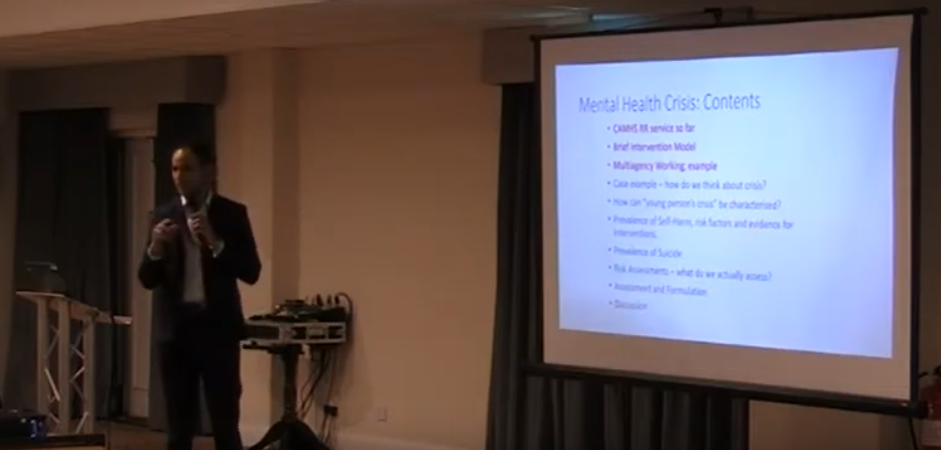
Dr Tauseef Mehdi, Consultant Child and Adolescent Psychiatrist, Berkshire CAMHS Rapid Response Service (RRT), kicked things off with his engaging presentation on Crisis and young people. He spoke of the important role of the RRT and described the Crisis stabilisation pathway for a young person which includes a comprehensive mental health needs assessment, a co-produced formulation to share with the young person, parents and partners, a multi-agency meeting and agreement of multi-agency care package, a CAMHS RRT stabilising intervention and transition to appropriate specialised service as required.
Dr Mehdi highlighted the importance of early identification and obtaining a shared understanding of unmet needs (anything that causes perpetual stress in a child) as this can be reversed and the first intervention is to work on this reversal as addressing this addresses the risk. He shared papers which described how difficult it is to assess risk in young people and how research shows that moving away from prediction to focusing on the needs of the person and seeing assessment as informing management rather than as a stand-alone activity is key.
There was a lot of interest in Dr Mehdi’s talk and we hope to invite him back to a later event to have a longer discussion.
The presentation for Session 1 is available here.
Dr Mehdi also provided resources for attendees:
Session 2: Attention Deficit Hyperactivity Disorder (ADHD)
Next up was Dr Rakendu Suren, Consultant Psychiatrist, Berkshire CAMHS, Berkshire Healthcare NHS FT who spoke about ADHD discussing the following elements:
- Epidemiology, Aetiology
- Assessment process
- Different screening questionnaires Qb test
- Co morbidity and differential diagnosis
- Treatment
- Transition to Adult services
- Shared care
Dr Suren shared an engaging video on treatment which can be found here.
The presentation for Session 2 will be available shortly.
Session 3: Autism
Dr Amy Balcon and Dr Kate Gordon, Clinical Psychologists from the Autism Assessment Team, at Berkshire Healthcare NHS FT gave an overview of autism, some tips for managing communication and the consultation environment and guidance on when, where and how to refer.
The presentation for Session 3 is available here.
The following resources were also suggested:
- Autism Berkshire: http://www.autismberkshire.org.uk/
- Parenting Special Children: https://www.parentingspecialchildren.co.uk/
- National Autistic Society: https://www.autism.org.uk/
Session 4: eating disorders – spotting the signs
We reconvened after a short interval to hear from Emma Regan, Family & Systemic Psychotherapist/Clinical Nurse Specialist and Clinical Team Lead, CYPF Berkshire Eating Disorders Service (BEDS).
Emma described the service and the referral pathway and highlighted the following key points confirmed by the evidence:
- Early intervention is associated with improved outcomes
- Early weight restoration predicts good outcome
- Specialist outpatient treatment is best for most cases
- Family involvement is important
She presented on spotting the signs of eating disorders, when to be concerned, and what is involved in specialist support. This included highlighting the use of the SCOFF questionnaire and the Junior Marsipan guidelines. She also highlighted the information which GPs can provide which helps support the referral noting that BMI alone is unreliable under age 18, when weighing pre-referral it is important to ensure that coats, shoes and heavy jumpers are taken off and the importance of obtaining Inorganic Phosphates bloods.
The presentation for Session 4 is available here.
Additional resources provided for this session:
- Beat Guide to understanding eating disorders
- Caring for a child or adolescent with an eating disorder
- Marsipan Report
Please find the link to the app referred to which includes the risk assessment tool and %mBMI calculator (available as Android or iphone/ipad mobile app) and the code that will be required to access it initially:
App: http://www.marsipan.org.uk/calculator
Passcode: 2690d7e8c7a9ec03e2cc907514c53617
Session 5: Update on mental health support teams in schools
Andy Fitton, Assistant Director of Joint Commissioning, NHS Berkshire West CCG described the core elements of the Green Paper proposals to have Designated Senior Leads for Mental Health in schools and colleges and Mental Health Support Teams working across schools and colleges.
He shared the planned model for Berkshire West and the schools involved in the three teams. The list of these can be found here. It was noted that East Berkshire are developing their model and this will be shared with East Berkshire GPs shortly.
The presentation for Session 5 is available here.
Session 6: Psychological perspectives in education and primary care
To round off the event, we heard from Lisa Thomson, Berkshire Lead PPEPCare (Psychological Perspectives in Education and Primary Care) trainer about the available PPEP care training modules for primary care which can be delivered in surgeries. An information sheet regarding these can be found at this link.
The aim of the training is to help those in the frontline to recognise and understand childhood mental health issues better, and equip these professionals with some basic skills and the confidence to help support children/young people and their families (including some useful psycho-education that can be shared).
The presentation for Session 6 is available here.
Lisa also highlighted some useful resources including:
- Information & resources for young people coping with anxiety and/or depression and their families
- A leaflet on Unhelpful thinking styles
- The MindEd website, a free e-learning resource to help adults to identify and understand children and young people with mental health issues.
Additional resources
You can view presentations and resources from the latest Oxfordshire GP study session here.
For presentations and films from previous GP study sessions, click here.