Regional Palliative and End of Life Care Strategic Clinical Networks were re-established nationally in September 2020. This includes a Palliative and End of Life Care Network to cover the South East region. The terms of reference are available on the Palliative and End of Life Care Clinical Collaborative pages of the Futures NHS website. To access the website, please e-mail sherree.fagge@nhs.net, Head of Nursing, National Palliative and End of Life Care Team.
People often ask what the difference is between Palliative and End of Life Care?
Palliative Care is for people who have a serious illness in which a cure is no longer possible. It involves controlling symptoms that have a rapid onset or progression and assuring the patient and their families or carers of the best possible experience in terms of quality of life. This involves managing the symptoms of the illness as well as managing social, spiritual, and psychological needs.
End of Life Care is an important part of palliative care for people who are nearing end of life. It aims to help people live as well as possible and to die with dignity. End of Life Care continues for as long as it is needed.
Legacy
Wessex had a Clinical Network for Palliative and End of Life Care from 2016-2018. Thames Valley had a Clinical Network for Palliative and End of Life Care from 2012-2018. The AHSN ran a similar network in Kent Surrey Sussex during this period. Then funding for Palliative and End of Life Care networks ceased.
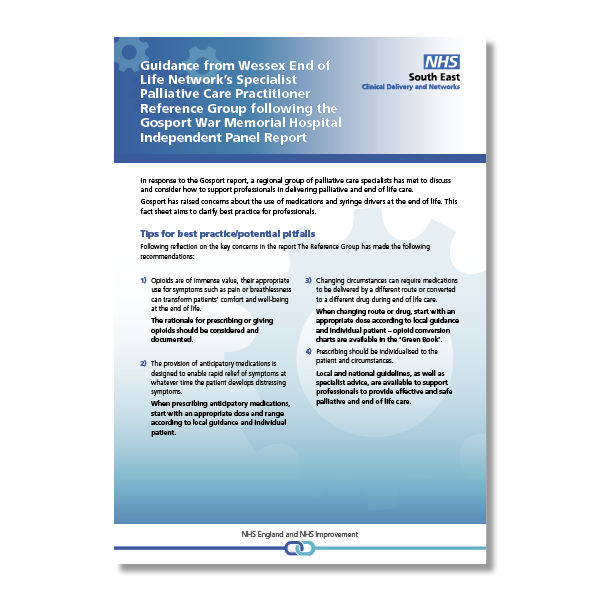
An informal network of professionals and experts with a real interest and passion for improving palliative and end of life care across the Wessex region, which has existed for some time. They are responsible for the production of The Green Book – a good practice guide which is now in its ninth edition and aimed at clinicians working in this field, and they recently produced of a set of three guidance documents on the use of medications and syringe drivers available here.
A unified approach to recording the patient’s wishes was agreed across Hampshire and Isle of Wight. You can view the associated document here.
For the duration of the Thames Valley End of Life Care Network, the programme focused on and developed a number of resources including an exemplar urgent care pathway, worked with CCGs to undertake an audit of their EPaCCS systems, and ran a pilot providing specialist palliative care advice via the 111 service.
Both networks hosted video masterclasses here.
2020/2021
The national team ran a series of briefings for clinicians working in Palliative and End of Life Care during COVID-19. They are saved on the Futures NHS website (details for access given above).
The Director of Nursing wrote to each Sustainability and Transformation Partnership (now Integrated Care Systems) asking them to nominate a Senior Executive, Clinical Lead and Commissioning Lead to deliver the Palliative and End of Life Care programme in their patch. The programme should be shaped by the National Ambitions website. A self-assessment tool originally developed by the Cheshire and Merseyside Palliative and End of Life Care Network is available here for systems to use.
Please contact england.mhldasoutheast@nhs.net if you would like to know who your ICS Palliative and End of Life Care Leads are.
From the beginning of the COVID-19 pandemic, there were concerns that ‘do not attempt cardiopulmonary resuscitation’ (DNACPR) decisions were being made without involving people, or their families and/or carers if so wished, and were being applied to groups of people, rather than taking into account each person’s individual circumstances.
In October 2020, the Department for Health and Social Care commissioned CQC to conduct a special review into these concerns. Their review, which took place between November 2020 and January 2021, looked at how DNACPR decisions were made in the context of advance care planning, across all types of health and care sectors, including care homes, primary care and hospitals and made a number of recommendations for systems. The report and summary is available here.
Further reading
To understand more about policy framework:
- Government response to the review of choice in end of life care
- National end of life intelligence network (Public Health)
- Ambitions for Palliative and End of Life Care: A national framework for local action 2015-2020
- Commissioner guidance for end of life care
- Shifting the balance of care report
- End of life care and human rights
To understand more about the inequalities around end of life care: